Thursday, June 27, 2013

Pepacton Reservoir Brown Trout - June 26, 2013


I made the drive to Downsville, NY to fish the world famous Pepacton Reservoir for reservoir-run brown trout. I met up with Rick Flanders and we launched at around 10 am after steam cleaning our kayaks at Al's Sportshop.

The trout were rising out of the water pretty consistently on some spent sulphur spinners from the prior night. The splashes were hard, and there were some big browns coming up as well. With the amount of rising trout, we hoped for a good day with active fish. Rick hooked up almost immediately with a nice brown trolling an alewife. 

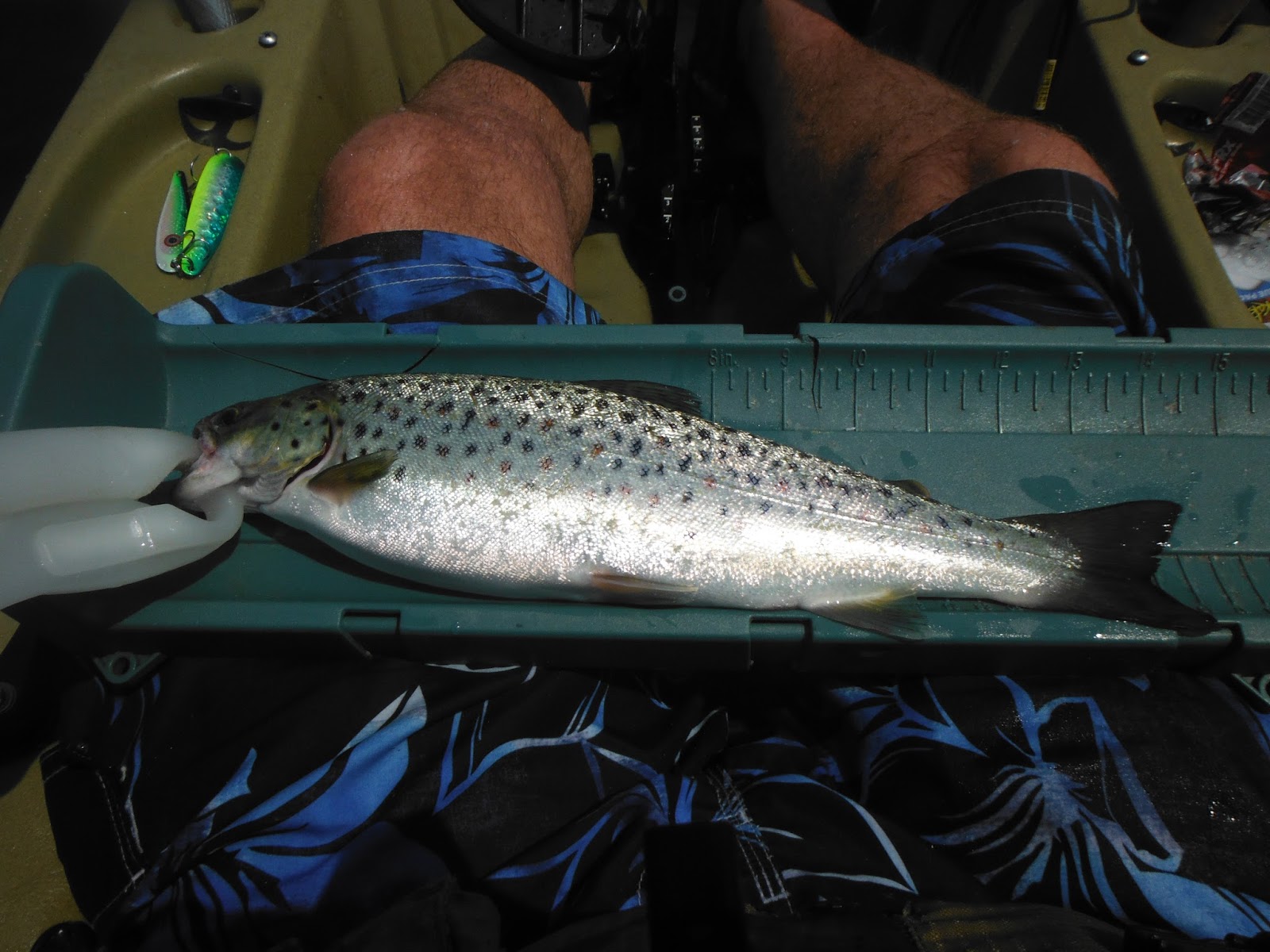
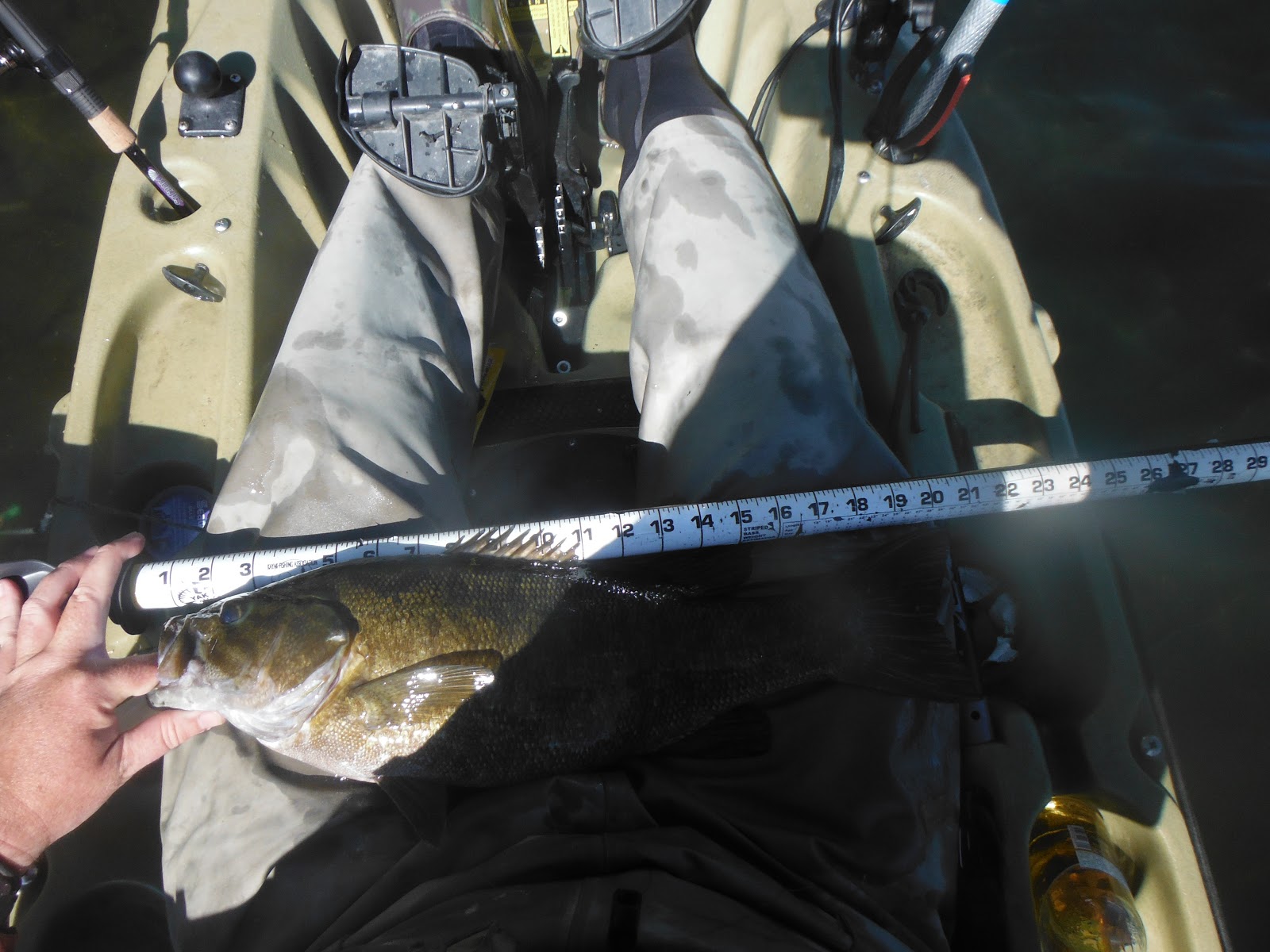
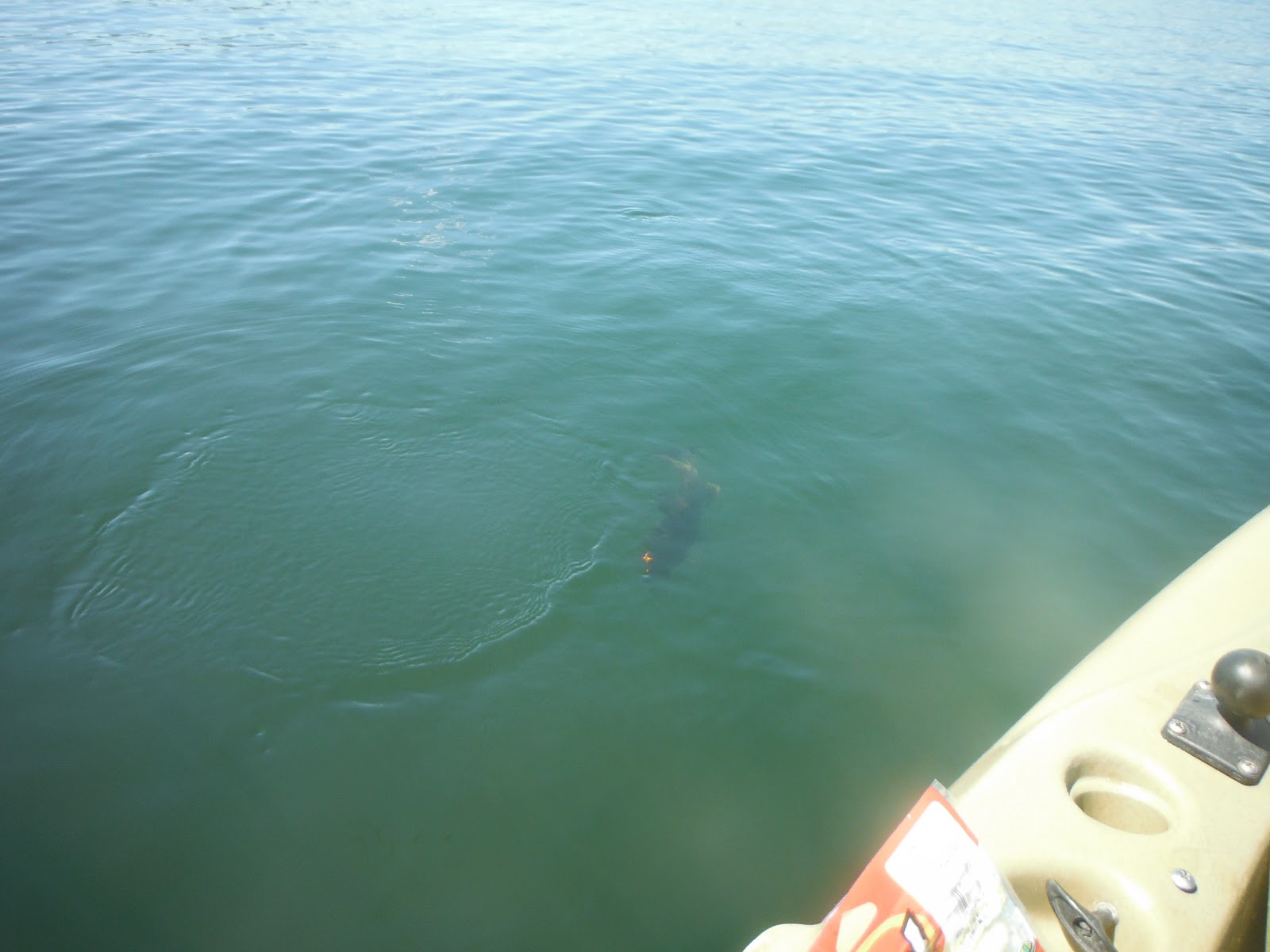
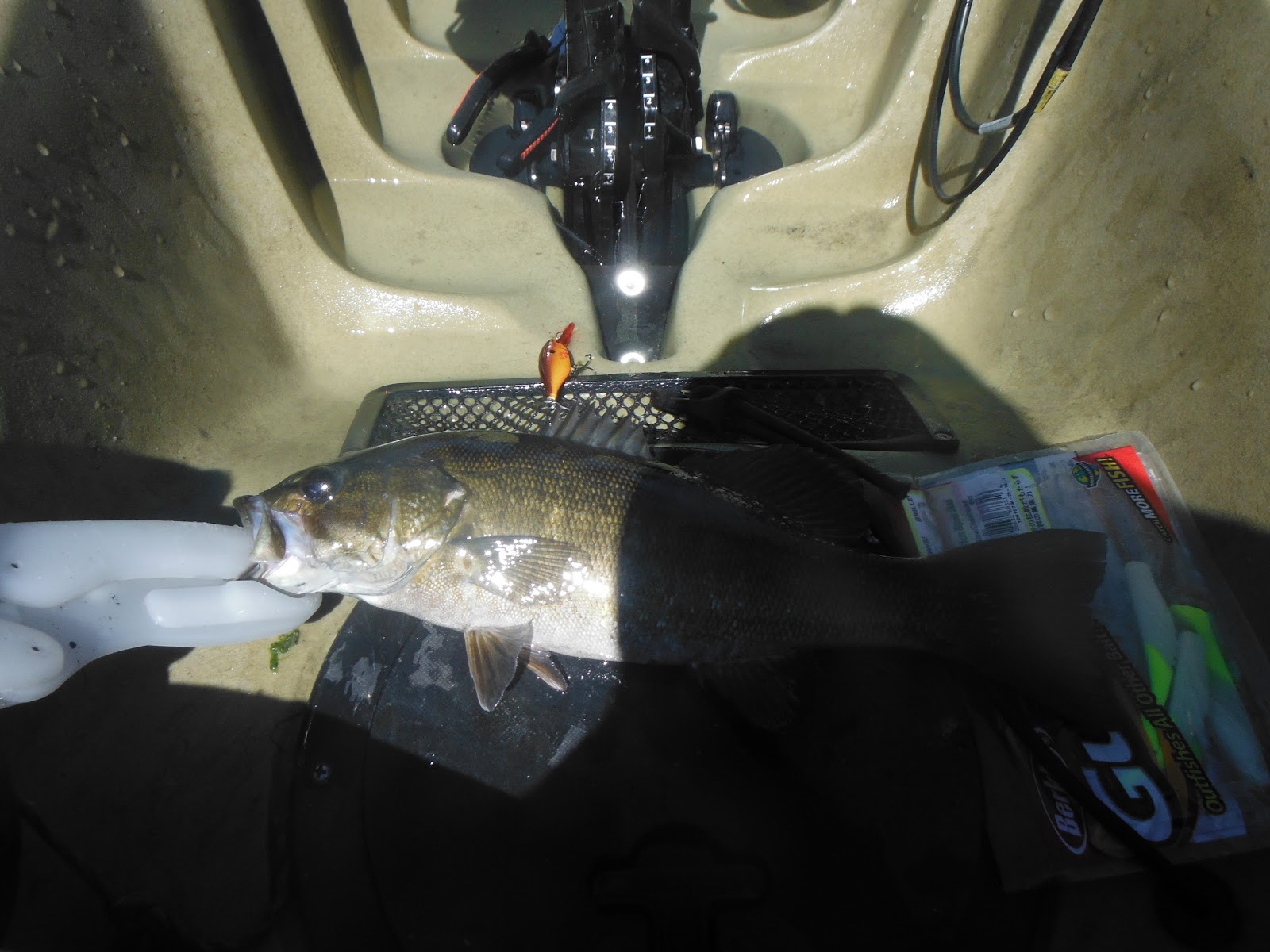
I was getting hit consistently, but didn't hook up until I hit the end of point that jutted out into a cove. After a solid fight, I netted a silver colored brown trout that measured 18". Like salmon and steelhead, brown trout become silver colored if they roam in deep open water like sea-run trout. I quickly revived and released the fish after a couple of pictures. 

I continued fishing inside the cove and soon hooked into a second fish as I reeled in my mooselook wobbler. This brown leaped out of the water and crashed back in after I hooked it on the surface only only a few feet from the yak. This brown measured 17". 

My third fish was a few minutes later trolling in the other direction. Again, this fish bounded for the surface after getting hooked. I landed another silverly brown trout, this time with large orange dots. These were the most uniquely colored brown trout that I have seen. To this point, all three of my browns were caught trolling mooselook wobblers on leadcore. 

I caught my forth brown trolling in the same direction This was my smallest fish of the day, just starting to get the silvery, sea-run look. 

By this time, it was a little after noon. It was bright and hot, and the next few passes yielded no more browns. Rick and I switched gears and started targeting smallmouths. The smallie bite was slow, and I picked away at two fish over an hour working some timber with crankbaits. The steep ledges around the reservoir may make plastics a better selection. 

We started trolling again at about 2:30 pm and decided to explore. We left the cove and covered about a mile of shoreline. Rick picked off two more brown trout at the point of the cove. I had some hard hits, but couldn't get one hooked in a couple of passes over the long stretch of shoreline. I headed back to the cove again, and hooked into a fish deep into the cove trolling in 28'. Initially, the fish wouldn't budge, so I thought I may be stuck. But, it started coming up and pulling hard and soon burst to the surface and leaped in the air about 2' near the kayak. Rick thought it was a smallmouth, but it turned out to be a stout, fat bellied 20" brown trout. I kept this fish and put it on the stringer. 

The late afternoon, early evening bite was a disappointing pick. After that brown, I only had a couple of hits, and we started to move our way back to the launch at about 6:30 am, but working some key spots that we had success on the other side of the little bay we fishing in the morning. 

We had focused most of our efforts in 30'. I find browns are more structure orientated than other trout and salmon species, so I looked for points of land and water were the thermocline met the bottom. We mostly ignored the thermocline in the open water, choosing to pick away at browns at the edges of steep ledges that started at 30' and dropped abruptly to 65' - 70'. While making a turn, I went through some deep water and started marking fish up and down the thermocline, which was setting up between 20' and 40'. The bottom depth was 70', so the browns were roaming the open water. This was a massive school of trout, but they wouldn't bite. We worked it hard, and I kept changing direction and speed. 

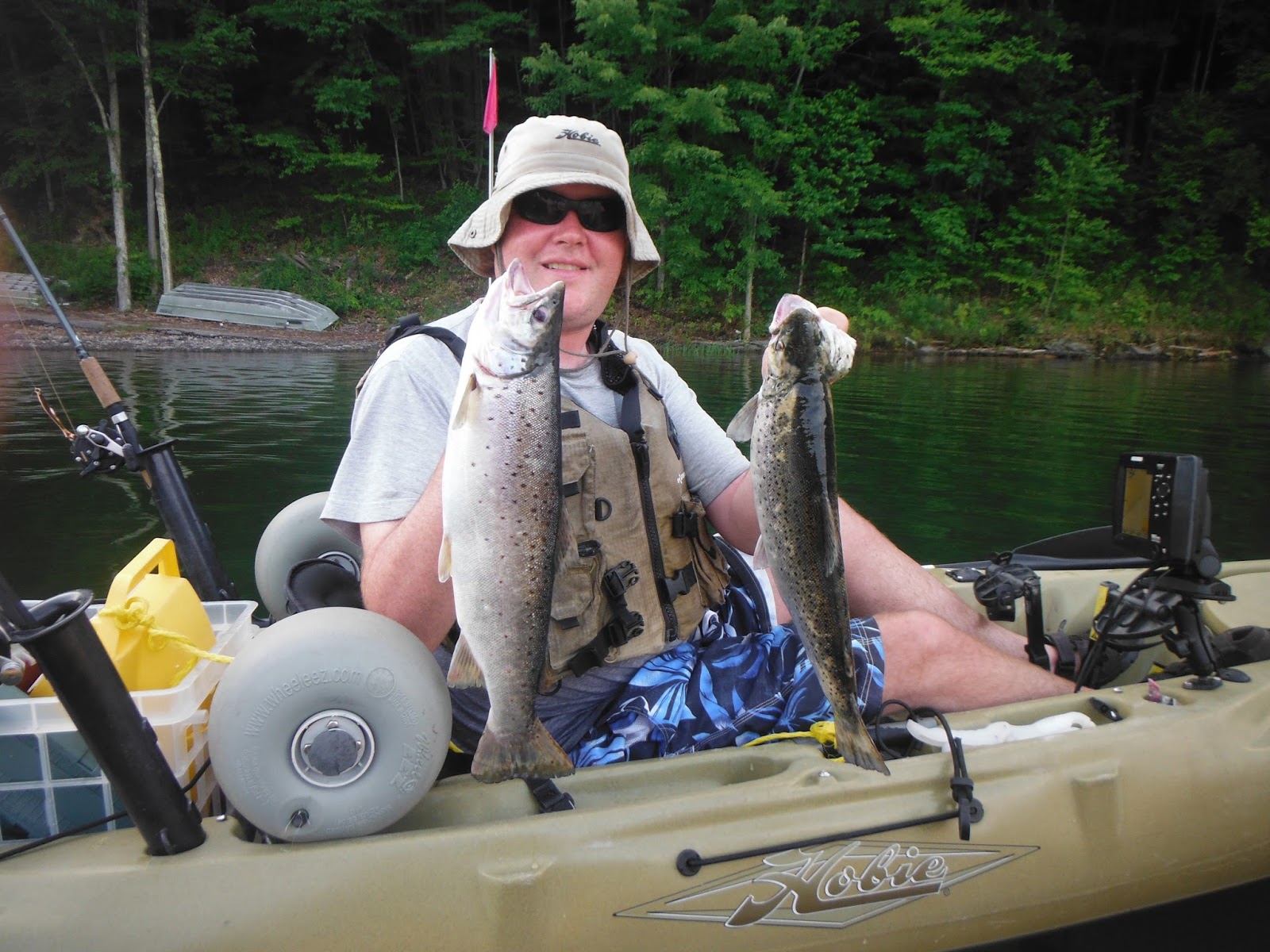
Soon, my rod doubled over hard and I heard an enormous splash behind the kayak. The brown soon jumped again, and I began a dogged battle on the surface with the largest brown of the day. The battle went subsurface, and the trout started taking drag, and twas controlling me, and not the other way around, and I was afraid I didn't have enough rod to land the fish. After another leap into the air, I got the brown to the boat and saw it was well hooked.  Despite some issues with my net, I landed a thick-bodied 22" brown trout, silver with bright red spots and perfect brown fins. I thought that this was likely my NYS citation catch and release brown, but it was short by two inches. Either way, it was a gorgeous fish and I was extremely happy to catch it. This fish was caught among the enormous school that I marked on my chart. After catching this fish, they were gone and that was the last fish of the day for either of us. 

The surface temperature was almost 74 degrees. 

I marked plenty of fish that day. Most of them were within the thermocline, whether that was in the bottom of the water column in 30', or out in open water in 70'. Often times it was a large body of fish spread out throughout the thermocline. Other times, and less often, they were above the thermocline congregated in tight pods herding the alewives. Three colors of lead was the order of the day, but I went down another color when I fished the open water because it looked like the majority of fish were holding in the 30' - 40' portion of the thermocline. 

It is important to note that the current from the Delaware River is very strong here, and the water moves like it would in a saltwater bay, only the tide never changes! You will find that you will move much faster with the current than against. Most of the fish that I caught were facing into the current, but my largest one was not. 

I caught 5 browns trolling a mooselook wobbler on leadcore. The other brown, and my smallest one, was caught on a live alewife trolled on leadcore. Best speed was approximately 1.8 - 2.0 knots. Faster and slower speeds weren't producing. 

I tied an 8' leader of 6 lb fluorocarbon to the leadcore. 

Pepacton is a great place to fish, and I will make it a point to get up there a few times per year. There is a two fish 15" limit on brown trout, with only one fish above 21" permitted. A NYC reservoir permit is required with a steam cleaning of your kayak. All the permits and long drive is well worth the effort. 

It is quite an ecosystem, and the reservoir is just as advertised - loaded with quality brown trout. 


Kokanee Salmon - June 8, 2013 and June 15, 2013


West Hill Pond, CT. 

Earlier this month, I made a day trip to West Hill Pond in CT to target kokanee salmon. Kokanees are landlocked sockeye salmon. Since they are Pacific salmon, they have a three year life cycle and die after spawning during the fall of the third year. Kokes are a western fish, and the vast majority of kokanee fisheries are west of the Rockies. There are only four kokanee fisheries east of the Mississippi. Two of these fisheries are in Connecticut, one in upstate New York, and a prolific fishery in North Carolina.

New York discontinued their kokanee program during the recession for budgetary reasons. The kokes only caught on in the remote Bug Pond in Hamilton County where a self-sustaining population exists today. Prior to discontinuation, several ponds in the Adirondacks had stocked populations of kokanee.

Connecticut continues their kokanee program and the fishery is on a rebound after alewives were illegally introduced to the kokanee lakes. Kokes are primarily plankton feeders and the alewives competed with them for plankton. As a result, the kokanee population went down and the alewives became overpopulated. Connecticut solved this problem by stocking larger brown trout that forage heavily on alewives. It looks like the population of alewives is down and the kokanee are making a good comeback.

Kokanee are one of the smallest salmon, and rarely exceed about 18" in length. They become big enough to catch during the third year of their life cycle. At this time, they start the spring at about 12" and will grow to as big as 17" by the end of the summer. Since all fish are from the same year class, they will generally all be the same size.

June afternoon on West Hill Pond. 
Like all salmon, kokes are quirky and this is a niche fishery in the truest sense of the word. Since they are plankton eaters, they only strike a lure out of anger or reflex. This makes flash and vibration two very important components to your arsenal of weapons. Flash is crucial to get the attention of the salmon. As such, trolling with flashers or dodgers is usually necessary. Niche lures are also a must, and bright Wedding Ring spinners were very productive for me. I also trolled Kokanee Killers, which is a plastic spoon. I had some hits on the Kokanee Killer, and even caught a nice brown trout on it, but it didn't produce any kokes for me.

Speed is another issue in this fishery. Kokes like a slow troll at approximately one mile per hour.

Most importantly, you need to tip your spoon or spinner with shoepeg corn. The scent is a huge attractor for the kokanee. Like I said, salmon are a quirky fish. Landlocked Atlantics are a very nuanced-based fishery as well.

Managing the leadcore at a slow speed was important. I estimated that my line was dropping about 12' per color while trolling at 1 mph. As such, I was trolling at 3 colors and my lure was in approximately 35'.

My first kokanee salmon. 
During my first trip, I started trolling two leadcore rods. One rod was rigged with a Kokanee Killer behind a Mack Double D dodger. The second rod was rigged with a wedding ring spinner behind a Luhr Jensen Flasher. I hooked into a fish almost immediately that I didn't land or see. Soon after, I caught a nice brown trout. After this, I hooked into another fish that started to fight me differently and harder. As it came to the boat, I thought that it was a rainbow trout, but as I got it closer, I saw different hues - silver with a dark blue mixed hue fading into bright purple. I noticed the different body type and realized that it was my first kokanee and I was extremely happy. It was a beautiful fish and looked very similar to some of the landlocked Atlantics that I have caught. The big difference was the lack of spots and a rounder, stouter frame on the kokes. My wife was kind enough to take a picture and I continued to fish.
I picked away at brown trout as bycatch the entire outing and caught 7 total browns to 16". These fish were not silvery in appearance and didn't look like they had been in the lake for too long.

Near the end of the day, I had just released a nice brown. I had left my other leadcore line with the dodger out. As I reeled it in, I noticed that I had a fish. It was fighting me differently than the brown and when it got near the boat, the fish went airborne. After jumping 3' in the air, I was sure it was a salmon and carefully brought it in and landed it. It was my second salmon of the day caught and was also caught on a wedding ring spinner. This time, it was behind a dodger.

On a three hour trip, I caught 2 kokanee salmon and 7 brown trout.

I returned the next week solo for a morning outing. The fishing was definitely slower. But, I got into my first fish of the day fairly early. Soon after hooking it, I saw it leap far behind the boat high into the air. I knew it was a salmon! After a final tussle next to the boat, I netted my first salmon of the day. For the rest of the morning, I lost several fish and caught 5 brown trout (all released). Near the end of the outing, I caught a second salmon that I lost next to the boat. This time, the dodger outproduced the flasher for trolling. But, all fish were caught on the wedding ring spinner again.

By August, these fish will be around 17", and I am looking to return to West Hill at that time to try for one last shot at these beautiful fish.


Friday, May 10, 2013

Big Pre-Spawn Smallmouths in Westchester County


Early spring on Lake Mahopac, NY


The first morning yielded several quality smallmouths. 


For once, I forgot my measuring board that morning and I really needed it. Although the fish dips in my lap, this smallmouth bass measured slightly over 21". It was my third qualifying species for the New York State Catch & Release Angler Achievement Award. I caught a total of three qualifying smallmouths that morning, including two smaller 19" smallmouths. 


Water clarity of about 5' on Mahopac. 


Some bass fishermen are smallmouth snobs. With the leaping ability of a salmon and the dogged attitude of a tautog, it is easy to see why someone could get hooked on these brown members of the bass family. In addition to providing great shallow water action along structure and dropoff's in the early spring, the smallies become almost semi-pelagic when the water becomes warm foraging on bait schools of baitfish in deep, open water.

For many years, I had a row boat on Cross River Reservoir in nearby Westchester County. Every spring, the pre-spawn smallmouth bass fishing would light up beginning in the last week of April and ending around the second week of May, when the bass would go on the spawn. During this time, the smallmouths schooled up tightly along dropoffs and fed heavily in anticipation of the spawn.

With lousy morning tides on Long Island, I decided to venture north to Westchester County to target pre-spawn smallmouths on Lake Mahopac. Typical of the area, Mahopac is a deep and rocky lake nestled in the hills of the Hudson Valley. There are several excellent smallmouth bass waters in a chain of lakes and impoundments in the higher elevation areas in downstate New York beginning with Mahpac moving east to similar smallmouth fisheries Cross River Reservoir and Sodum. The chains of lakes extend to western Connecticut with quality fisheries in Candlewood and Squantz.

Lake Mahopac is almost 600 acres and located closest to the Hudson River. Despite the size, I found I could easily cover almost the entire lake in a 3 - 4 hour trip. The two large islands make it a smaller lake.

I launched on Saturday morning at 9 am and fished until 12 pm. During that time, I caught 11 smallmouths from 15" to 21". In the mix were two 19" smallmouths as well and several that were around 17". I explored almost the entire lake from my kayak, and casted or trolled a good length of the shoreline and islands.

The smallmouths didn't appear to be on their beds yet. Everything I caught looked to be pre-spawn. These smallmouths were weighed down by their fat bellies when they went airborne after pulverizing my plug.

Small crankbaits were the order of the day. Trolling was the best method. Success was all about banging deep diving crankbaits into the rocks on the bottom. If the crankbait wasn't getting stuck, I wasn't hooking up consistently with smallmouths. The bass forage heavily on crawfish in Mahopac and orange was the magic color, out-producing minnow colors about 2:1.

I caught most of my fish in about 12', which was as deep as my crankbaits would run. The smallmouths were holding right on the edge of steep drop-offs, as close to the steep sloping shoreline as possible without getting too shallow. It looked like they were waiting below the edge for a quick meal. The fish were mostly schooled up and I found a nice school, and kept trolling back and forth. The fish were aggressive and hit about every pass. Eventually, I moved on and found a nice rocky flat and fished 4' - 8' and caught a few more casting.

On the way back to the launch, I found a submerged island that extended onto a big flat. While trolling, I hooked into a huge smallmouth that fought me for a few seconds and broke my 8lb flourocarbon. I would have really liked to see that fish. Unless I snagged a carp, it was likely an oversized smallmouth.

I ended the day catching a 17" smallie off the same structure and called it a morning at noon to make the one hour drive back to Long Island.

I got a later start the second day and fished from 12 pm to 3 pm. The school of smallmouths that I had found the prior day wasn't holding in the same area, and I could pull no smallmouths off the spot. I moved around considerably and had no success trolling. My only fish were caught casting crankbaits at the shoreline and fallen timber. A good amount of smallmouths were holding on the timber. The others were holding right on the edge of the dropoff, and often I could see the bass come off from the depths to the shallows and take the crankbait.

I caught fish all over the lake, but it was a slow pick with smaller fish and my biggest smallmouths of the day were 15" and 17". I caught 9 total smallmouths and a big 14" yellow perch.

The 22" smallmouth I caught on Saturday was my largest since 2008 and my third qualifying species for the New York State Angler Achievement Award. Once I hooked up, I knew I was into a very good fish. It gave me a dogged fight and quickly took drag as the fish ran deep and away from the boat. There is nothing like catching a big smallmouth - they fight like tog and jump like salmon.

During the 1990s, I travelled near and wide to fish for smallmouth bass. I have fished most of the better fisheries in NY, VT, and NH. The three most productive lakes I fished were Lake Memphremagog, Lake Oneida, and Lake Winnepesaukie. The best fishery by far was Lake Memphremagog. During the peak, the average sized smallmouth was 3 lbs and they were numerous, with a very good chance of catching some 5 lb - 7 lb smallmouths as well. I was impressed by the fishery at Mahopac. The quality and quantity of smallmouths reminded me of Lake Oneida based on the excellent fishing Saturday. The second day wasn't near that quality, but still quite productive and certainly on par with nearby Cross River Reservoir.

All fish caught and released. Here are some pics. For once, I forgot my measuring board on the first morning so had to improvise with the paddle for measurement.


This 14.5" yellow perch would have qualified for the NYS Angler Achievement Award but I already caught a qualifying perch earlier this season. 


Friday, May 3, 2013

Deep Pond


I got out on Deep Pond to target big chain pickerel and trout.

Deep Pond is a little kettlehole nestled in the woods on a boy scouts camp in eastern Long Island. The boy scouts limit the access to the pond to weekday use only with a NYS land access permit required. There are also some other restrictions as well. The only permitted access entails a quarter mile carry down a steep hill. It is a good idea to travel light for the haul back to the car.

Despite the time restrictions and difficult access, the pond is fished heavily. A cursory look at the sign-in sheet in the angler parking lot shows fishing activity of 2 – 4 fishermen per day.

Even though the pond is heavily fished, it is an excellent fishery for big pickerel, quality yellow perch, and the occasional holdover brown trout.

Pickerel is the biggest drawing card. The strict regulations and abundance of perch keeps Deep Pond one of the best big pickerel fisheries in the state. However, overfishing led to a drastic decline in the overall pickerel population. As a result, a no-kill restriction on pickerel is now imposed. This regulation is key to keeping this pond a trophy pickerel producer.

The deep oxygenated water of the pond and abundant perch population helps the stocked brown trout to holdover in Deep Pond. Occasionally, you will see thick pods of brown trout cruising the bottom on your fishfinder. Normally, these fish are foraging for food and actively feeding so try to get a presentation to them quickly before they move on. You will also see trout rise to late afternoon midge hatches as well. These fish are keyed into the hatch and will generally ignore other offerings.

With a late start, I wasn’t on the water until 4:30 pm and fished until dusk.

Over that time, I had a solid pick of quality fish working the drop-offs and structure around the little pond.

I caught and released four big chain pickerel, each between 22” and 24”.

I caught numerous yellow perch, but two quality specimens at 12” and 14.5” respectively. The latter qualifies for a NYS Angler Catch & Release Achievement Award. This is my second of the season and third qualifying NYS fish in two years (my others were chain pickerel and largemouth bass).

I caught all my fish working a Gulp paddletail on a lead head. I was working the lower half of the water column from the shoreline to 10’. Once my jig hit the bottom, the pickerel and perch would pick it up during the split second it was still. Usually, this occurred near the kayak.

For the second straight year, trolling for trout was unproductive. I used both a spinning rod and leadcore, neither of which yielded a hit. With the small size of the pond, it is difficult to get enough momentum for a good troll. For that reason, I recommend using leadheads here.

I caught no trout. At the end of the day, trout started rising on chironomids  and actively fed on midges until near dusk, when the dwindling light kept the hatch down. I didn’t have a fly rod, but actively worked these fish for about a half hour at the end of the day in 17’.

At one time, I marked a big pod of trout that moved through. This pod looked like a mini version of some of the readings I have seen on the Housatonic River or the Elizabeth River so it appeared as though they were actively feeding and directly under my kayak. So, I dropped my leadhead down to the bottom and started vertically jigging.  As soon as the jig hit the bottom, I lifted and got a solid hit, but I didn’t hook up. I quickly fan-casted the area, but it appeared as though the browns had moved on. The prior year, I had caught a big brown trout in the same area in the same situation.  It is a testament to the forage base and quality of fishing that I may have had a shot with holdover trout two years in a row. These were definitely not recent stockies, as it was a very good mark. I believe the lake holds a few trophy trout. Maybe if I had the entire day my result could have been different.

Otherwise , I only had a couple of light hits working the trout that were fixated on the midge hatch. Although the trout were slurping midges, I doubt I would have had much success if I had brought my fly rod and some midge patterns. The trout seemed to be mostly spooked by the kayak, and generally kept about 20’ away. I doubt I have the skill to cast a size 28 midge larvae 20’ sitting from the kayak.

At dusk, the hatch had stopped and the rising trout ceased, so I made my way back to the car. The carry back to the jeep was certainly a workout, but very doable and worth it. The more I fish this little pond, the more I want to come back. 


Tuesday, April 30, 2013

Soft Plastics and Big Stripers and the Radar Pier


36" striper caught on 10" hogy.


Biggest striper of the day at 37"

I got out last Saturday morning with Eric Harrison on Jamaica Bay. As a Hogy rep, Eric is a big soft plastics fisherman and has designed some hardware for Hogy for targeting striped bass around structure. He is the master at fishing soft plastics for big stripers and every fishing trip with him is like taking a PhD level class in fishing. Eric grew up fishing the coast of southern California and honed his skills in the big fish waters of Massachusetts fishing around Boston Harbor and catches as many trophy stripers as anyone on the coast.

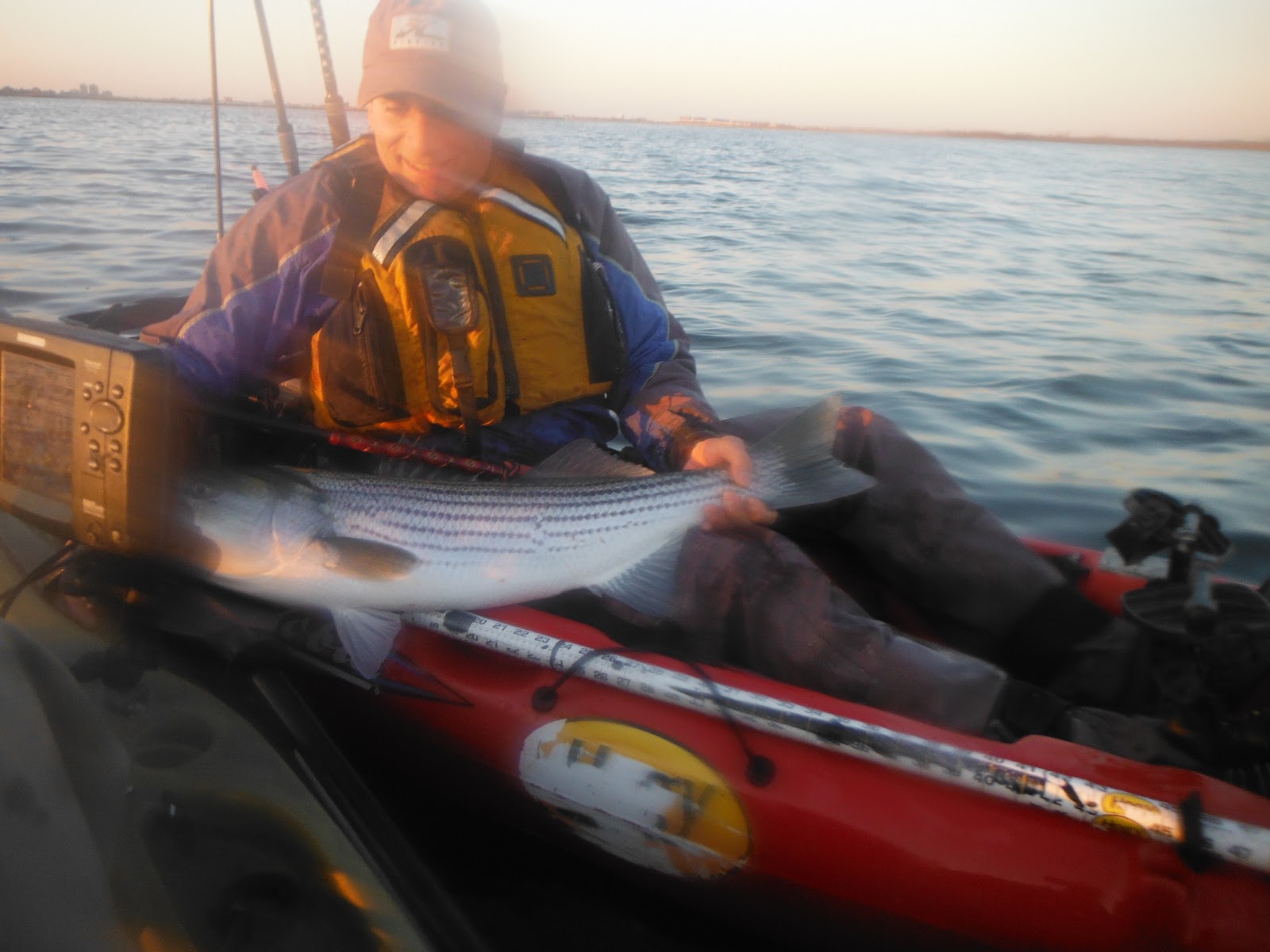
So, I dedicated the day to fishing Hogy soft plastics with him. I picked his brain about using them for stripers and got an excellent tutorial on fishing the deep channels of Jamaica Bay with soft plastics. We fished the last three hours of the flood in area west of the railroad bridge to the ruined radar pier and had a slow pick of quality fish to 37". All of my fish were at least 30" and my largest was 36".

There was a slight WNW wind, that was a little higher than predicted. This WNW wind combined with an incoming tide gave us a good drift across some fairly productive water.

We had success pulling stripers out of bunker schools in 25' using 10" Hogys. The key was either marking or seeing bunker and fishing through them. Most of the time, we would be bumping bunker only to have our jig thumped hard by a big striper. When the bunker would disappear, the bite stopped. The bunker were moving around fast and the stripers were moving with them in hot pursuit. As such, we moved around quite a bit.

Retrieve was key to getting hit. For me, I let the jig fall to the bottom and worked it up - the odder the retrieve, the more hits I got. My best retrieve was a long haul with a few periodic hard twitches to keep it in the middle of the water column, away from the surface. During the pause between twitching the plug, I would often receive a violent hit from a striper. When the action was good, I was always hitting bunker. It was easy to tell the difference between bumping bunker and a striper hit.

We both caught fish by the radar pier, but the up-current side of the pier was the better producer. This surprised me because usually the bass hold at the down-current side of pilings. But, all of the bunker was on the up-current side of the pier as well.

The bite slowed as the top of the flood approached and the bunker spread out. The stripers also spread out, and we hardly marked any stripers moving through the channel at all on our journey back to the launch.  While the tide was incoming, we had periodic marks of stripers but very rarely were the stripers schooled up except for one occasion. Otherwise, we would mark a lone big striper moving through the middle of the water column. I saw one once that looked to be about 4'. It was the biggest mark I ever saw on my fishfinder.

Great fishing and it isn't even the peak yet.

We discovered that the bluefish are moving in. Eric had several plastics bitten off. I expect to see them in hordes next weekend.

Also, there were some weakfish caught by others. With some reports of weakfish in the area, I did a scoping mission on Sunday morning. I got a late start and fished for 90 minutes before the south wind came up and blew out the afternoon. No weakfish for me but I expect them to be in better numbers next weekend. I believe they are in there in numbers right now. I just have to find them. For the next three weeks, I'm likely dedicating one scouting mission per week until I find some.