Wednesday, January 7, 2015

Kayak Fishing for Cod - Massachusetts - October, 2014

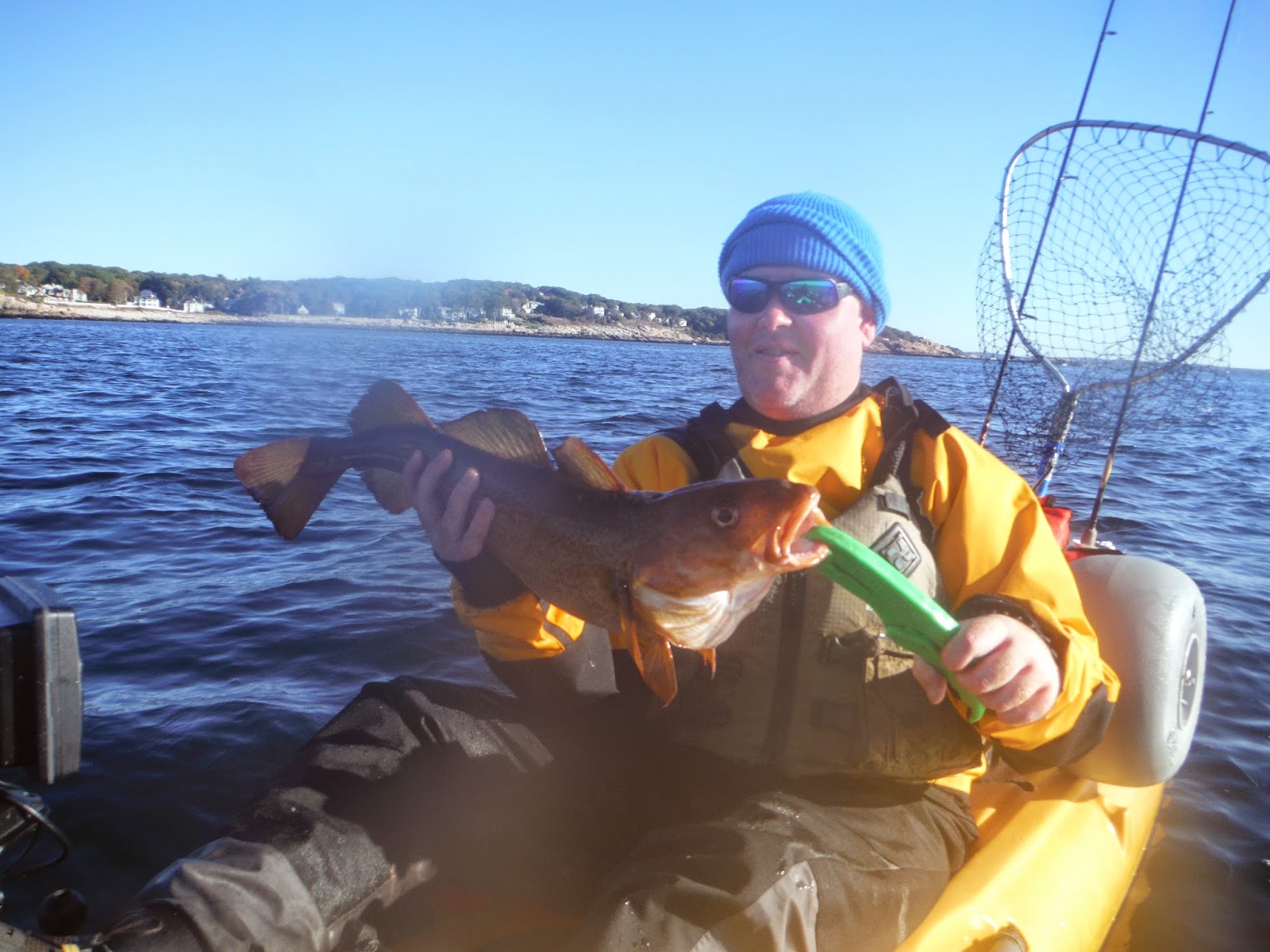
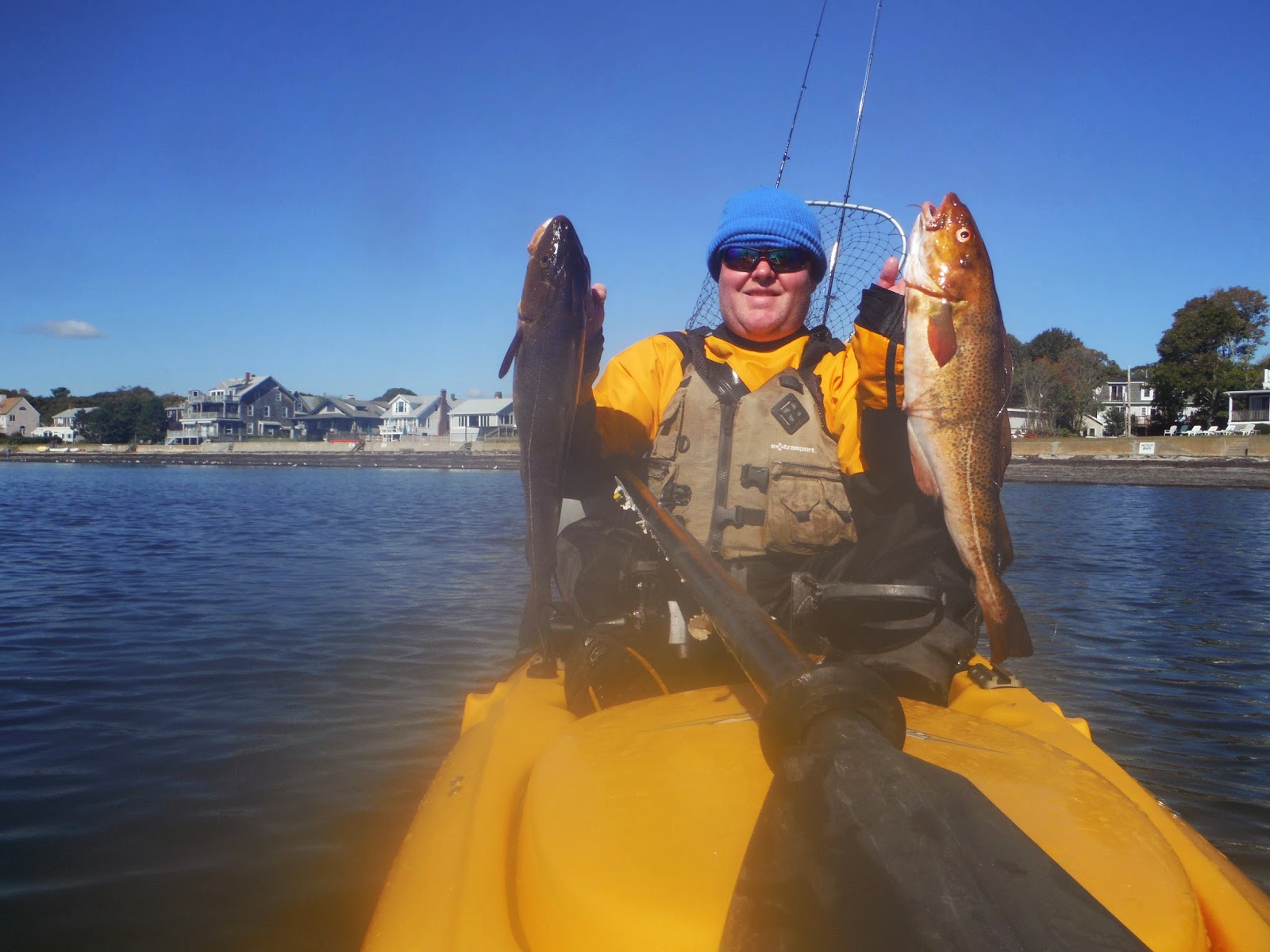
I travelled to the Massachusetts coast on Columbus Day weekend for a short trip. Each morning, I fished for about the first three hours after dawn targeting cod, which is something that has been on my bucket list for a long time. I've never caught a cod before and to catch one from a kayak was special. I was lucky enough to have two friends in the area that were inshore cod sharpies. The first day, Eric Hromada showed me the ropes in terms of targeting cod and looking for appropriate structure to find them. In terms of structure, we were fishing sunken islands in 50' - 80' and reading our sonar for boulders and scattered rocks along the bottom where the cod were congregated. The cod were moving from area to area quickly for a bottom fish (sort of like black sea bass), so locating a few good humps with some rocks allowed us to move with the cod. It was a great morning and my largest cod was 28". The second day, Eric Harrison showed me a different area with similar results with my largest cod being about 26". We were fishing with a larger group including Mike Baker and Mike Bartgis, who travelled all the way up from Maryland, and James Fisher and everyone caught some cod. Baker, who made the trip down from Maine, caught the largest cod of the day at 31". The final morning I went solo and worked some GPS waypoints. Although it was a little slower since 1/3 hours included fishing during the slack tide, I still caught several cod with my largest being about 27". There was an onshore wind the final day and the new revo handled the choppier weather well. Over three mornings, I caught over 30 cod. I caught all my cod on non-baited jigging spoons with 2 ounce gold hammered diamond jigs and hogy sand eels producing best. Cod are definitely underrated fighters, and the toughest part was pulling them off the bottom. After hooking up, they dig into the bottom and make a strong run that doubled over my medium spinning rod to the point it looked like it would break! I was vertically jigging these cod and they almost always took the jig on the rise, which is unusual because almost every other species I target grabs it on the drop. The water temp was 55 degrees but the air temp was in the low 40s, so it was much cooler than down here on Long Island where I'm still wearing swim trunks in mid-60s water temps. Oh, and the cod hate slack water. It was great seeing everyone, as I hadn't seen a couple of those guys since the spring. Thanks again so much to Eric Hromada and Eric Harrison for taking some time out and showing me around. It was greatly appreciated. I couldn't ask for better hosts or better company. Here are some pics:





Kayak Fishing Tautog Opening Weekend 2014

It was very rainy day to open the tog season and I was soaked even with good rain protection and a dry top. It was a solid bite on shallow water tog, and I caught about 15 tog with my largest being 22.5", 22.5", and 21". Here are some pictures. I started on the Sound but it was too rough so I moved inshore. It was cold out there with constant rain and felt more like November.


Thursday, October 23, 2014

September Albies - Stonington Invitational - Watch Hill, RI

Each September I take off some time to fish saltwater from the kayak. September can be the best month of the year for weakfish and if the albies show, the month can produce some of the best variety of quality fish for the year. 

The albies hadn't shown in force in this area since 2012. Last year, the inshore run of pelagics was short and only in a few isolated areas. This year, the albies showed up with a vengence and the fishing was very good for my two trips to Watch Hill, RI. 

My two trips to Watch Hill were on September 17 and three days later on September 20 for the Stonington Invitational. 

On my birthday, I took the day off and targeted false albacore from the kayak in western Rhode Island with Tom Comito. After a 4 am wakeup on LI, I opened the dawn on the water on the Block Island Sound to a nice September sunrise over the Watch Hill lighthouse. The albies were already busting out of the water by the time we got there and we both caught. There wasn't much wind, and the albies weren't up for too long, and I caught all my fish blindcasting and also one trolling. Today, flies were the order of the day and sand eel patterns produced. It was the first time that I caught an albie trolling and I wasn't disappointed - it gave me an unbelievable fight even on a stiff medium mini surf rod with a 5000 class reel. 

A few days later, I went back to fish the Stonington Invitational  with Rick Hacker. This was sponsored by Stonington Marina. This time, we encountered two different species. In addition to false albacore, Rick jigged up a couple of bonito as well. These were Ricks first pelagics and I believe he is addicted as well. It was a tough bite and the albies weren't crashing bait on the surface so they were tough to find and we had to blind cast to catch them. I hooked into 4 albies and landed 3. I also caught my personal best alibie, which measured 27". Three hookups on flies, one on plastic. I caught this fish on a medium spinning rod and the battle may have been the best I ever had. These fish are no joke and are the most tireless fighters in open water that I have encountered. The fight is constant, and sometimes they turn on a dime and come back towards the kayak, which makes you feel like you have lost them. The weather turned bad so I only stayed for the day. In fact, the surf was far worse than Magic Seaweed had predicted. Instead of 1' swells, it was a constant 4' swell by mid-morning, with standing waves up to 6' on the big rip. It was a white knuckler getting through the rip near low tide, but there was only shore break on the beach. Seas were predicted to be worse today so I cancelled my reservation and drove home in the mid-afternoon.


Wednesday, October 1, 2014

Long Island Fisherman Magazine - Article - Harbor Hopping on the Western Sound


The Fisherman Magazine published an article that I wrote this month entitled Harbor Hopping on the Western Sound. The article discusses kayak fishing the fall striper fishery in the harbors and bays of the western Long Island Sound on the north shore of Long Island. I've been fishing this pattern for about 7 seasons and it is very reliable. The consistency of the pattern is especially important as a backup plan to summer-run weakfish, whose presence can vary from season to season. It is also a good contingency plan if pelagics like false albacore / bonito don't show, which is another local fishery that sometimes lacks consistency. Also, if you can't make it to the east end to fish the fall run at Montauk, this can be a good alternative. This fishery is quantity over quality. Although you won't catch many trophies, 20 - 40 stripers per trip is the norm. Most of these fish will be from 20" - 27". This issue also contains another article about kayak fishing featuring some familiar faces such as Eric HarrisonElias VaisbergShawn UncleDuke Barham, and CaptJerry Collins. The Fisherman Magazine is focusing on the growing trend of kayak fishing and this is my third article this year and fifth in last three years. Magazines are starting to recognize the substantial number of anglers that are abandoning boat and surf to fish from kayaks. I greatly appreciate the opportunity and recommend checking the magazine out. Here are some pictures.

Summer Bottom Fishing - Long Island Sound - Scup and Black Sea Bass

For most of August, I dedicated one evening after work to targeting scup on some rockpiles near points on the western Long Island Sound. Usually, I would fish from about 7 pm until dark. Tactically, I was diamond jigging with 1 ounce jigs tipped with sandworm or Gulp. The scup liked a horizontal retrieve and held in tight schools over certain structure, so a GPS was useful for working schools and eliminating dead areas. Vertical jigging wasn't as productive, but also worked on nights where the scup were aggressive. Over three weeks, I caught several scup in the 18" range. 

I also jigged up some keeper sea bass as well to about 17", which was a really nice bonus. This is the first time I saw nice sea bass so far inshore and I hope it was the start of a trend. 


September Night Stripers on the Long Island Sound - 9-2-14


 Yesterday night after work, I targeted stripers for the first time since May withGeorge Terezakis in the western Long Island Sound. We fished the rocks near Mattinicock, NY from kayaks. One of the few benefits of living on Long Island is the quick access to good saltwater kayak fishing. Within a 20 minute drive, we access some really nice beaches within an easy paddle to the boulder fields of the Sound. We had good success and caught several schoolie stripers. The stripers will be transitioning soon to the harbors and a good bite on plastics and metal occurs for the next two months. With 92 degree temps during the day, it was really nice to be out on the Sound with a cool breeze on the water . . . . not too many nights like this left now. As always, good fishing with George. Below is a picture of typical stripers from last night.

Tuesday, August 26, 2014

Kayak Fishing for Kokanee Salmon - August 24, 2014

Kokanee are landlocked sockeye salmon. They don't grow as big as their sea run counterparts and are similar in size to brook trout. One of my goals for the fishing season was to catch a kokanee that qualifies for a CT trophy award. In CT, the kokanee must be at least 17" to qualify for a catch and release award. 

Last year, I had fished West Hill Pond on two occasions in June and caught about 5 kokes with my largest being about 15". For this season, I planned on two trips to East Twin Lake. Both lakes are located in the western part of northern CT.

The kokanee fishing is challenging. Firstly, it is a niche fishery which requires specialized equipment. For the kayak angler, leadcore with dodgers or flashers is a must. Shoe peg corn is also necessary.

After hooking into one, the loss rate is high because the kokes have very soft mouths and I've seen the hook clear straight through the mouth, so a gentle rod tip is valuable as well.

Further, you must troll very slow at about 1 mph for the kokes to hit.

With all the nuances, you must specifically target kokes and they are rarely caught as bycatch.

I had a productive morning and caught 3 kokanee. Each salmon was 14". I used a wedding ring spinner  behind a flasher.

I like East Twin a little more than West Hill because it is much bigger, which leads to longer trolls and the ability to cover a larger territory. However, I travelled a long way before I could find the kokes. They were in 30' and some as deep as 40'. I marked trout higher in the thermocline at 20'.

The kokanee I caught were similar in size to last year and didn't appear to be turning yet. Kokes have a three year life cycle and all of the fish I caught were third year salmon that will begin to turn red in about a month.

I will be returning on September 9 for one more shot at a big fish before the fish begin to turn and stop feeding.

Thursday, July 17, 2014

Kayak Fishing Sanibel Island and Captiva - Snook, Redfish, Jack Crevalle, and Trout - June 19, 2014 - June 22, 2014

A snook from the flats on the Pine Island Sound east of Sanibel Island, FL
I made a kayak fishing trip to the Sanibel / Captiva Island in Florida with my buddy George. Captiva and Sanibel are two barrier islands located off the coast of Fort Myers. Between the Gulf of Mexico and the Pine Island Sound are bayous, creeks, small keys, and passes each surrounded by mangrove shorelines. The bottom is composed of areas of both sand and mud that grow significant grass. It is no doubt a healthy ecosystem with substantial marine mammals as well, such as dolphins and manatees. 

Much of Sanibel Island is protected parkland and development is limited. The combination of these two factors have resulted in very good fish populations of such popular gamefish as snook, redfish, jack crevalle, and speckled trout. We encountered all four species on the trip while fishing off the beach in the Gulf, the backwaters / bayous, and the Pine Island Sound. These four species made for a nice Gulf Coast slam less the prestigious tarpon. 


It was all shallow water sight fishing in low light conditions and the feeding period where the snook and redfish were really aggressive only occurred for a brief time. The fish were wise to our artificial lures but would let their guard down in spurts. The higher water fished better but moving water coupled with low light was the largest factor for success. 


Typical Pre-Dawn Snook
On the first afternoon after arriving, I launched the kayak off the beach to fish the Gulf along a pass but had no success so I changed gears to flsh some backwater flats prior to dark and caught 3 snook in a drain that was pushing out water from a bayou between two mangrove islands on the outgoing tide. A big snook broke my 12 lb fluorocarbon leader against coral which taught me a lesson to upsize to 25 lb. There were reds tailing the flats adjacent to this drain that would not take my offerings. 


On the second day, I slept later and travelled farther into the Pine Island Sound to the scope out the area. Launching at 8 am was too late. I couldn't find any snook or redfish in the backwaters. So, I headed out to the Pine Island Sound to fish the area around the Wulfert Keys for speckled trout and redfish. I found a nice trout on the flats but otherwise saw no signs of life at the keys so headed back in for the morning. In hindsight, I wish I woke up and stopped fishing earlier. Although I found some actively fish feeding in a mangrove cove, the sight fishing was over by 9 am. I believe the fish sought the cover of the mangroves as the sun moved higher. 


My buddy arrived around noon on the second day and we started fishing again around 5 pm. We travelled outside the mangroves and found a oyster bar adjacent to a channel stacked up with tailing redfish in 12" of water. It appears that the reds were rooting out crabs and were very difficult to catch. However I managed a nice slot redfish on a Johnson's Minnow spoon that I quickly released after a picture. My friend lost a very big snook on the flats as well using a Zara Spook. The snook appeared to be in the 30" class. 


The next morning, we launched before dawn and found moving water with snook and and jacks crashing bait between the mangroves and a sandbar pre-dawn and the fishing was excellent. We both caught snook and jacks during the pre-dawn feeding frenzy. Before sunrise, we found 30" snook almost beached in 4" of water. The oyster bar from the night before also produced a nice snook for me. George lost a snook boatside that broke his line that was about 3' long. Overall, it was an excellent morning for snook. No reds during that outing though. 


Redfish were actively


patrolling the flats during
the late afternoon


We had low and stagnant water for our afternoon fishing and both caught nothing nor saw many fish feeding except for some reds near the oyster bar that had produced the prior day, but far fewer than the night before. As the tide tailed out, those fish stopped feeding as well. We headed back in a little bit early. 


The last morning, George made sure we on the water extra early, but the crashing fish that had greeted us the prior morning were gone, and there was only sporadic feeding activity around our usual spots. George hooked into a nice snook that he lost pre-dawn . . . . and then there was a lull. At dawn, the incoming tide started moving faster and water began to flush over the 10" flats, pushing in some baitfish. At sunrise, I caught a nice snook in a drain adjacent to the mangroves on a zara spook which was the start of some epic morning flats fishing for snook and redfish. 


As the sun went higher, predators started feeding heavily on the flats - snook pushing baitfish and reds tailing for crabs. We began to cast gold spoons and got into fish immediately. My first fish was a slot sized redfish that took me on some drag screaming runs in very shallow water, digging in hard like a typical red. After this, the fishing became hot, and I started to get hit or catch a snook on almost every cast for about a half hour. The snook were aggressively feeding in very shallow water. 


The snook were more


plentiful and aggressive 
than the redfish
As the sun got higher, the fishing waned and the bite became slow. I hit our oyster bar one last time, but had no success. By about 9:30 am, we decided to call it a trip. I had one last area that I wanted to fish before going in, and stayed out after George to work this spot. On my first cast, which was near the mangroves, I got hit and the fish started to run hard. As such, I knew it was a big fish and the battle began. First, the fish raced outside towards a sandbar, and I battled him back to the kayak where I went to grab my net, fighting the fish the entire time. But, maybe I fought the fish too hard to keep it away from the sandbar because it turned harder than I could handle towards the kayak and the mangroves. As I got the fish to the kayak, I saw that it was a snook in the 30"+ range and grabbed the net. At this point, the snook turned it up a notch and rolled straight to the mangroves. I've turned big striped bass away from piers and rocks with similar tackle, and initially, I got the snook away from the mangroves, but I couldn't turn this fish on the second run, and she took drag, turned the kayak brought my fishing rod behind me as she ran for the roots where she subsequently cut my 25" fluorocarbon against some coral and barnacles inside the mangroves. After this, I called it a trip. I'm glad I hooked into that snook, but wish I got a picture. It would have been the perfect way to end the trip. But, such is fishing. 

Special thanks to Captiva Kayak Company who outfitted us with great fishing kayaks for the trip. The shallow nature of the fishery makes Mirage Drive-powered kayak less appropriate than normal circumstances. The kayaks we used were designed for fishing skinny water in the flats and held up well. Captiva Kayak Company delivered the kayaks to our cabins at Castaways fully loaded and we fished that area the entire trip. 

We stayed at a cabin in the Castaway Resort. It was perfect for our fishing trip, with access to the Gulf of Mexico, Pine Island Sound, and several different bayous inside both Sanibel Island and Captiva Island. I highly recommend it for a fishing trip and plan to go back in February. 

Sanibel / Captiva is the ultimate in inshore fishing in Florida. The remoteness of the islands keeps the fishing pressure from boats low with easy access to a vibrant ecosystem. I can't wait to get back! 


We rented our kayaks from Captiva Kayak Company in McCarthy's
Marina on Captiva Island. 

Much of our fishing required staking our kayaks and wading the flats


in water 6" deep. 

Typical redfish for the trip. It was the best redfish bite I've experienced
in Florida. 

Nice redfish could be found in the late afternoon and early monring


near oyster bars and on the flats. 


An early morning redfish on the Sanibel Flats. 


As the tide rose, redfish pushed bait to the very edge of the flat in 
inches of water. 


Snook could be found on flats adjacent to mangroves during low 


light periods with moving water. As the sun became higher in the
sky, they moved deep into the mangroves. I lost some snook to 
the mangroves and coral.